> ## Documentation Index
> Fetch the complete documentation index at: https://docs.kinetica.com/llms.txt
> Use this file to discover all available pages before exploring further.
# Query
Click **Query** in the top navigation menu to access several data
management tools.
## SQL Tool
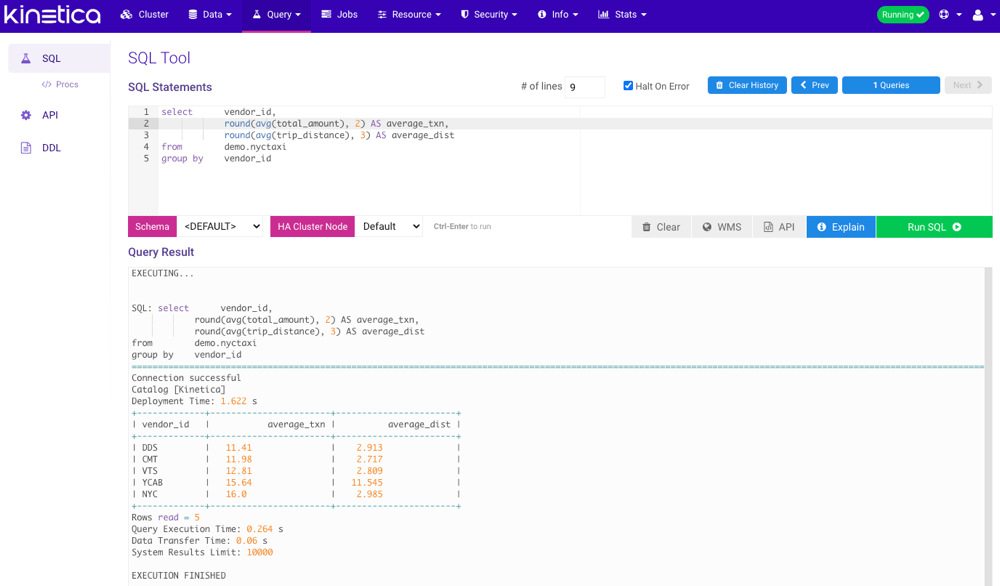
The *SQL Tool* allows you to perform SQL queries against the data in
*Kinetica* from [GAdmin](/content/admin/gadmin). The *SQL Tool* works similarly to the
SQL Lab in [Reveal](/content/bi/reveal) but has fewer
restrictions. To read more about using the *SQL Tool* from the command line
(also known as *KiSQL*), review [Kinetica SQL (KiSQL)](/content/tools/kisql).
Several actions are available from this tool:
* Increase or decrease the **# of lines** to increase or decrease the
size of the **SQL Statements** box.
* Select **Halt on Error** to halt SQL query execution if an error
occurs. This is particularly useful when executing several statements in
sequence as this will break on the first error in that sequence
* Click **Clear History** to remove all previously executed queries from
the list.
* You can view and page through your query history using the **\< Prev**
and **Next >** buttons, or view & select (for re-execution) from the
entire history using the **Queries** button in between them. Once the
**SQL Query History** window is open, use the filter box to search
the history for a particular value and click a query to re-load it.
* You can select a **Schema** to run queries in by default allowing you
to query without specifying a fully qualified table name, e.g.,
`FROM schema.table_name`. You can query outside of the set schema by
providing a different schema in the **SQL Statements** area.
* If [HA](/content/ha) is enabled, you can select a particular
**HA Cluster Node** to run the provided query against.
* Click **Clear** to clear both the **SQL Statements** &
**Query Result** areas.
* After entering a query into the **SQL Statements** area, click
**WMS** to create a WMS call from the query, which will place the
results in a temporary table and open the [WMS](/content/admin/gadmin/data#gadmin-table-wms)
window. Once done browsing, close the WMS window to delete the temporary
table.
* After entering a query into the **SQL Statements** area, click
**API** to generate the Python code necessary to run the same query
via the native Python API.
* After entering one or more semicolon-terminated queries and/or DML/DDL
commands into the **SQL Statements** area, click **Explain**
to output a visual execution plan of the provided query.
* Select a portion of the text entered into **SQL Statements** and click
**Run Highlighted** to execute only the selected portion.
* After entering one or more semicolon-terminated queries and/or DML/DDL
commands into the **SQL Statements** area, click **Run SQL**
to execute.
The WMS and Explain functionality can act on everything in the
**SQL Statements** area or highlighted text, but they cannot
be executed if there are multiple statements in the text area with
nothing highlighted.
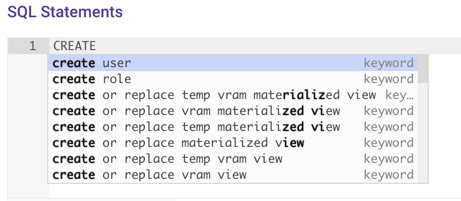
 SQL snippets and autocomplete are also available to help expedite writing
queries.
SQL snippets and autocomplete are also available to help expedite writing
queries.
 ### Explain
The explain plan visualizer is a graphical complement to using the `EXPLAIN`
[keyword](/content/sql/query#sql-explain) in a given query, providing visual detail to the
SQL query's execution plan, execution time, and native API translation(s).
The explain plan visualizer cannot be used in conjunction with
the `EXPLAIN` keyword.
Clicking **Explain** will not execute the query (initially); the
database will walk through the native actions necessary to execute the query
and show the plan. Once the query plan is output, the query can be executed and
analyzed using the **Run & Analyze** button (with **Verbose**
optionally providing more execution detail).
For example, the executing the following:
```sql theme={null}
EXPLAIN
SELECT
n_begin.ntaname AS boro_begin,
boro_end,
COUNT(*) AS total_trips
FROM
(
SELECT pickup_latitude, pickup_longitude, n_end.ntaname AS boro_end
FROM demo.nyctaxi t
JOIN example_geospatial.nyc_neighborhood n_end ON STXY_INTERSECTS(dropoff_longitude, dropoff_latitude, geom)
)
JOIN example_geospatial.nyc_neighborhood n_begin ON STXY_INTERSECTS(pickup_longitude, pickup_latitude, geom)
GROUP BY 1, 2
```
Yields a text-only explain output:
```
+------+-------------------------+----------------------------------------------------------------------------------------------------------------------------------+------------------------------------------------------------------------+----------------+
| ID | ENDPOINT | INPUT_TABLES | OUTPUT_TABLE | DEPENDENCIES |
+------+-------------------------+----------------------------------------------------------------------------------------------------------------------------------+------------------------------------------------------------------------+----------------+
| 0 | /create/jointable | demo.nyctaxi AS TableAlias_0_,example_geospatial.nyc_neighborhood AS TableAlias_1_ | sys_sql_temp.Join_3_01234567_89ab_cdef_0123_456789abcdef | -1 |
| 1 | /create/jointable | sys_sql_temp.Join_3_01234567_89ab_cdef_0123_456789abcdef AS TableAlias_0_,example_geospatial.nyc_neighborhood AS TableAlias_1_ | sys_sql_temp.Join_5_01234567_89ab_cdef_0123_456789abcdef | 0 |
| 2 | /aggregate/groupby | sys_sql_temp.Join_5_01234567_89ab_cdef_0123_456789abcdef | sys_sql_temp.ShardedAggregate_7_01234567_89ab_cdef_0123_456789abcdef | 1 |
| 3 | /get/records/bycolumn | sys_sql_temp.ShardedAggregate_7_01234567_89ab_cdef_0123_456789abcdef | | 2 |
+------+-------------------------+----------------------------------------------------------------------------------------------------------------------------------+------------------------------------------------------------------------+----------------+
```
Running the same query (without the `EXPLAIN` keyword included) but this time
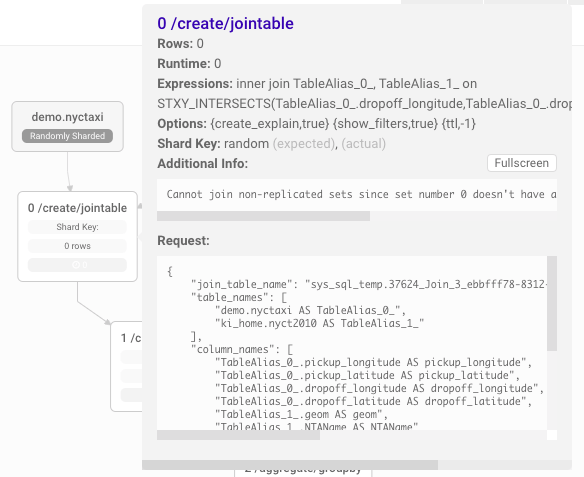
clicking **Explain** would yield the graphical query plan:
### Explain
The explain plan visualizer is a graphical complement to using the `EXPLAIN`
[keyword](/content/sql/query#sql-explain) in a given query, providing visual detail to the
SQL query's execution plan, execution time, and native API translation(s).
The explain plan visualizer cannot be used in conjunction with
the `EXPLAIN` keyword.
Clicking **Explain** will not execute the query (initially); the
database will walk through the native actions necessary to execute the query
and show the plan. Once the query plan is output, the query can be executed and
analyzed using the **Run & Analyze** button (with **Verbose**
optionally providing more execution detail).
For example, the executing the following:
```sql theme={null}
EXPLAIN
SELECT
n_begin.ntaname AS boro_begin,
boro_end,
COUNT(*) AS total_trips
FROM
(
SELECT pickup_latitude, pickup_longitude, n_end.ntaname AS boro_end
FROM demo.nyctaxi t
JOIN example_geospatial.nyc_neighborhood n_end ON STXY_INTERSECTS(dropoff_longitude, dropoff_latitude, geom)
)
JOIN example_geospatial.nyc_neighborhood n_begin ON STXY_INTERSECTS(pickup_longitude, pickup_latitude, geom)
GROUP BY 1, 2
```
Yields a text-only explain output:
```
+------+-------------------------+----------------------------------------------------------------------------------------------------------------------------------+------------------------------------------------------------------------+----------------+
| ID | ENDPOINT | INPUT_TABLES | OUTPUT_TABLE | DEPENDENCIES |
+------+-------------------------+----------------------------------------------------------------------------------------------------------------------------------+------------------------------------------------------------------------+----------------+
| 0 | /create/jointable | demo.nyctaxi AS TableAlias_0_,example_geospatial.nyc_neighborhood AS TableAlias_1_ | sys_sql_temp.Join_3_01234567_89ab_cdef_0123_456789abcdef | -1 |
| 1 | /create/jointable | sys_sql_temp.Join_3_01234567_89ab_cdef_0123_456789abcdef AS TableAlias_0_,example_geospatial.nyc_neighborhood AS TableAlias_1_ | sys_sql_temp.Join_5_01234567_89ab_cdef_0123_456789abcdef | 0 |
| 2 | /aggregate/groupby | sys_sql_temp.Join_5_01234567_89ab_cdef_0123_456789abcdef | sys_sql_temp.ShardedAggregate_7_01234567_89ab_cdef_0123_456789abcdef | 1 |
| 3 | /get/records/bycolumn | sys_sql_temp.ShardedAggregate_7_01234567_89ab_cdef_0123_456789abcdef | | 2 |
+------+-------------------------+----------------------------------------------------------------------------------------------------------------------------------+------------------------------------------------------------------------+----------------+
```
Running the same query (without the `EXPLAIN` keyword included) but this time
clicking **Explain** would yield the graphical query plan:
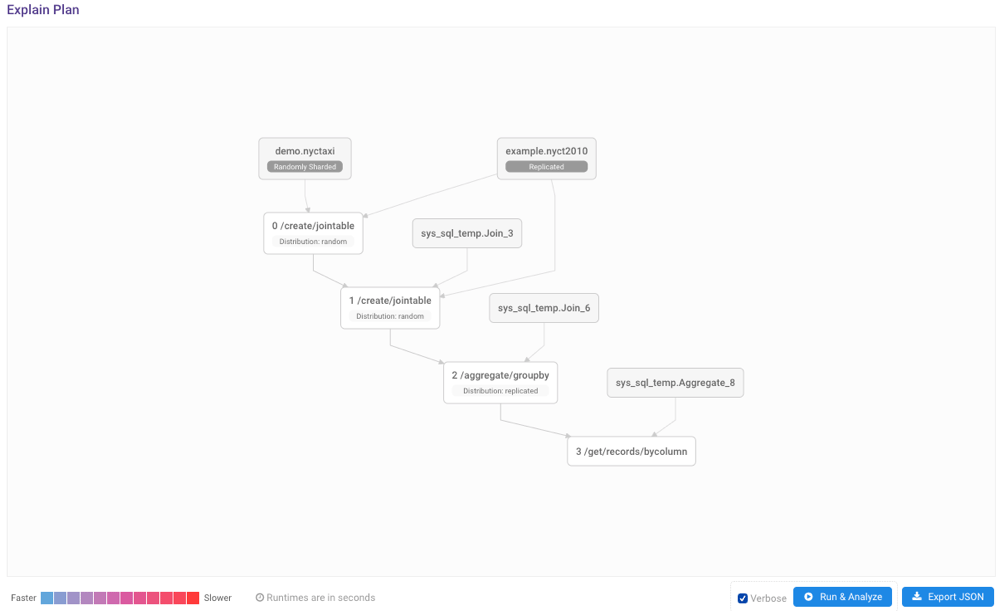 Hover over steps in the query plan to view the API call that would
occur in the background when executing the original query. Hover over
table names to view the table's schema. Click **Export JSON**
to export the text-based explain output to a JSON file.
Subsequently, click **Run & Analyze** to execute the query and see the
execution time for each step in the plan.
Hover over steps in the query plan to view the API call that would
occur in the background when executing the original query. Hover over
table names to view the table's schema. Click **Export JSON**
to export the text-based explain output to a JSON file.
Subsequently, click **Run & Analyze** to execute the query and see the
execution time for each step in the plan.
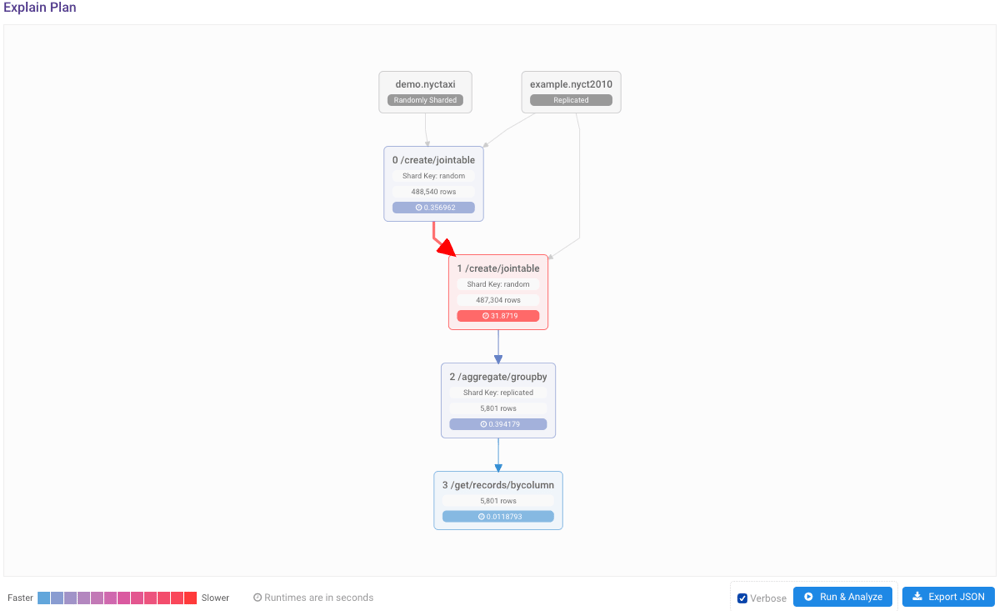 The steps are color-coded based on how fast they were in relation to the other
steps in the query.
If an error occurs in the query, it will be displayed in the plan at the point
it occurred. Mousing over the error will show the details of the call and the
error message.
The steps are color-coded based on how fast they were in relation to the other
steps in the query.
If an error occurs in the query, it will be displayed in the plan at the point
it occurred. Mousing over the error will show the details of the call and the
error message.
 ### SQL Procedures
The **SQL Procedures** page displays all existing SQL procedures. Review
[SQL Procedures](/content/sql/procedure#sql-procedures) for more information on SQL procedures.
* Click **Create** to create a SQL procedure.
* Click **Execute** to manually execute the selected procedure. Note
that any returned rows will not be displayed. Execute the procedure manually
via the [SQL tool](/content/admin/gadmin/query#gadmin-sql) to view any output.
* Click **Drop** to remove the selected procedure.
* Click **Permissions** to adjust the execute permissions for the
selected procedure.
* Click **Detail** to display the SQL procedure's definition.
### SQL Procedures
The **SQL Procedures** page displays all existing SQL procedures. Review
[SQL Procedures](/content/sql/procedure#sql-procedures) for more information on SQL procedures.
* Click **Create** to create a SQL procedure.
* Click **Execute** to manually execute the selected procedure. Note
that any returned rows will not be displayed. Execute the procedure manually
via the [SQL tool](/content/admin/gadmin/query#gadmin-sql) to view any output.
* Click **Drop** to remove the selected procedure.
* Click **Permissions** to adjust the execute permissions for the
selected procedure.
* Click **Detail** to display the SQL procedure's definition.
 #### Create
The SQL procedure creation process is simplified when using the interface;
all that's required to get started is some SQL code.
1. From the **SQL Procedures** page, click **Create**.
2. Provide a **Name** for the procedure.
3. Optionally, provide an **Execution Interval**. Units can be one of
the following:
* `SECOND[S]`
* `MINUTE[S]`
* `HOUR[S]`
* `DAY[S]`
4. Optionally, provide a **Start Timestamp**. The provided value should
be in the following format:
```
YYYY-MM-DD [HH:MM[:SS]]
```
5. Provide one or more semi-colon-separated SQL statements in the
**Statements** text field. Review the
[supported statements](/content/sql/procedure#sql-procedures-statements).
6. Click **Create**.
#### Permissions
While all SQL procedures are able to be viewed by any user, they can only
be executed by certain users. To adjust the execute permissions for a particular
SQL procedure:
1. From the **SQL Procedures** page, select a SQL procedure and click
**Permissions**.
2. Adjust the permissions as necessary:
* Edit execute permissions for users:
* *Add*: Click a user in the **Available** list and
then click **Grant >>** to grant the user `sql_proc_execute`
permission on the selected SQL procedure.
* *Remove*: Click a user in the **SQL Proc-level Granted** list and
then click **\<\< Revoke** to revoke the user's
`sql_proc_execute` permission on the selected procedure.
* Edit execute permissions for roles:
* *Add*: Click a role in the **Available** list and
then click **Grant >>** to grant the role `sql_proc_execute`
permission on the selected SQL procedure.
* *Remove*: Click a role in the **SQL Proc-level Granted** list and
then click **\<\< Revoke** to revoke the role's
`sql_proc_execute` permission on the selected procedure.
## API Tool
The *API Tool* allows you to call any *Kinetica*
[REST endpoint](/content/api/rest) with a given set of parameters.
**Request Mode** allows the choice of two methods for passing parameters
in endpoint calls:
* [Builder](/content/admin/gadmin/query#aqt-builder) - assign values to named parameters individually
* [JSON](/content/admin/gadmin/query#aqt-json) - pass the request as a single block of JSON text
The result of the request is output to the **Logs** panel. Click
**Clear** at the bottom to clear the output.
The **History** tab lists previously executed commands and their
results. Click **Reload** to load the selected endpoint and
associated parameters into the **Builder** for subsequent re-execution.
Click **Clear Saved Queries** in the top right-hand corner to delete the
query history.
Clicking the **API Docs** button will print the corresponding
documentation entry for the endpoint in the **Logs** panel to the right.
#### Create
The SQL procedure creation process is simplified when using the interface;
all that's required to get started is some SQL code.
1. From the **SQL Procedures** page, click **Create**.
2. Provide a **Name** for the procedure.
3. Optionally, provide an **Execution Interval**. Units can be one of
the following:
* `SECOND[S]`
* `MINUTE[S]`
* `HOUR[S]`
* `DAY[S]`
4. Optionally, provide a **Start Timestamp**. The provided value should
be in the following format:
```
YYYY-MM-DD [HH:MM[:SS]]
```
5. Provide one or more semi-colon-separated SQL statements in the
**Statements** text field. Review the
[supported statements](/content/sql/procedure#sql-procedures-statements).
6. Click **Create**.
#### Permissions
While all SQL procedures are able to be viewed by any user, they can only
be executed by certain users. To adjust the execute permissions for a particular
SQL procedure:
1. From the **SQL Procedures** page, select a SQL procedure and click
**Permissions**.
2. Adjust the permissions as necessary:
* Edit execute permissions for users:
* *Add*: Click a user in the **Available** list and
then click **Grant >>** to grant the user `sql_proc_execute`
permission on the selected SQL procedure.
* *Remove*: Click a user in the **SQL Proc-level Granted** list and
then click **\<\< Revoke** to revoke the user's
`sql_proc_execute` permission on the selected procedure.
* Edit execute permissions for roles:
* *Add*: Click a role in the **Available** list and
then click **Grant >>** to grant the role `sql_proc_execute`
permission on the selected SQL procedure.
* *Remove*: Click a role in the **SQL Proc-level Granted** list and
then click **\<\< Revoke** to revoke the role's
`sql_proc_execute` permission on the selected procedure.
## API Tool
The *API Tool* allows you to call any *Kinetica*
[REST endpoint](/content/api/rest) with a given set of parameters.
**Request Mode** allows the choice of two methods for passing parameters
in endpoint calls:
* [Builder](/content/admin/gadmin/query#aqt-builder) - assign values to named parameters individually
* [JSON](/content/admin/gadmin/query#aqt-json) - pass the request as a single block of JSON text
The result of the request is output to the **Logs** panel. Click
**Clear** at the bottom to clear the output.
The **History** tab lists previously executed commands and their
results. Click **Reload** to load the selected endpoint and
associated parameters into the **Builder** for subsequent re-execution.
Click **Clear Saved Queries** in the top right-hand corner to delete the
query history.
Clicking the **API Docs** button will print the corresponding
documentation entry for the endpoint in the **Logs** panel to the right.
 ### Builder
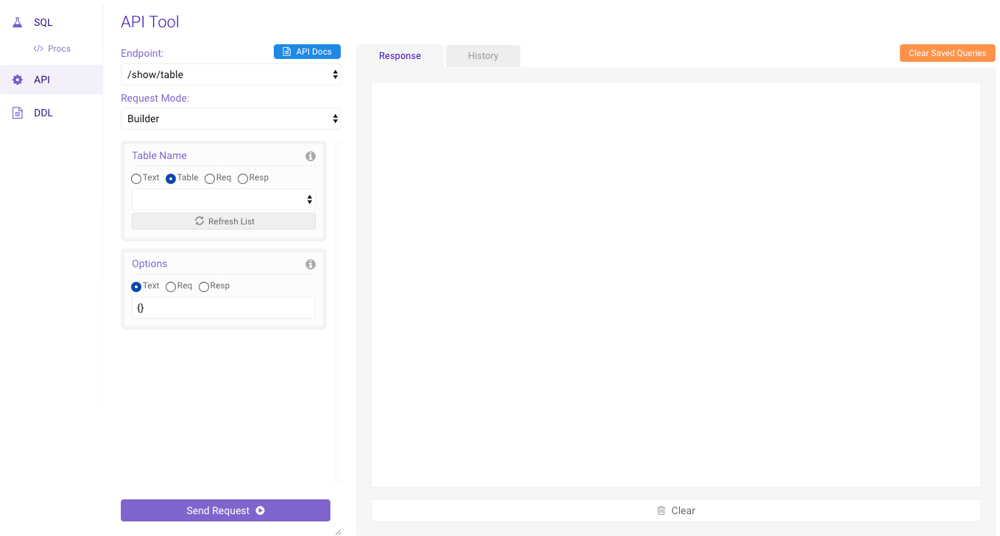
The **Builder** mode of the *API Tool* displays a user entry
control for each of the selected endpoint's parameters. Each control will show
the parameter name & type and the option to enter the parameter as
**Text** or to use a parameter from the previous request's
**Response** or **Request** object. The last set of parameters
used in an endpoint call will be saved until the next time the endpoint is
queried.
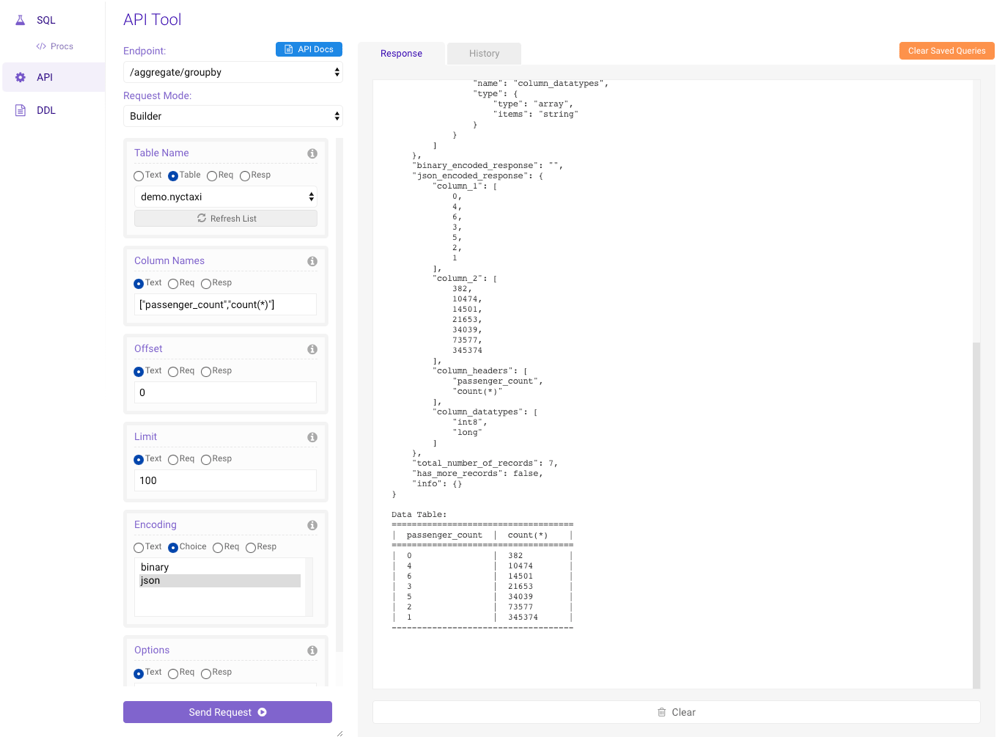
Each request will log the request parameters in JSON format at the top of the
**Logs** panel to the right. This request block can then be fed back
into the *API Tool* in [JSON](/content/admin/gadmin/query#aqt-json) mode, which may facilitate
repeated querying, as the entire request can be seen and modified at one time.
Here is an example of a request to the [/aggregate/groupby](/content/api/rest/aggregate_groupby_rest) endpoint
in **Builder** mode:
### Builder
The **Builder** mode of the *API Tool* displays a user entry
control for each of the selected endpoint's parameters. Each control will show
the parameter name & type and the option to enter the parameter as
**Text** or to use a parameter from the previous request's
**Response** or **Request** object. The last set of parameters
used in an endpoint call will be saved until the next time the endpoint is
queried.
Each request will log the request parameters in JSON format at the top of the
**Logs** panel to the right. This request block can then be fed back
into the *API Tool* in [JSON](/content/admin/gadmin/query#aqt-json) mode, which may facilitate
repeated querying, as the entire request can be seen and modified at one time.
Here is an example of a request to the [/aggregate/groupby](/content/api/rest/aggregate_groupby_rest) endpoint
in **Builder** mode:
 ### JSON
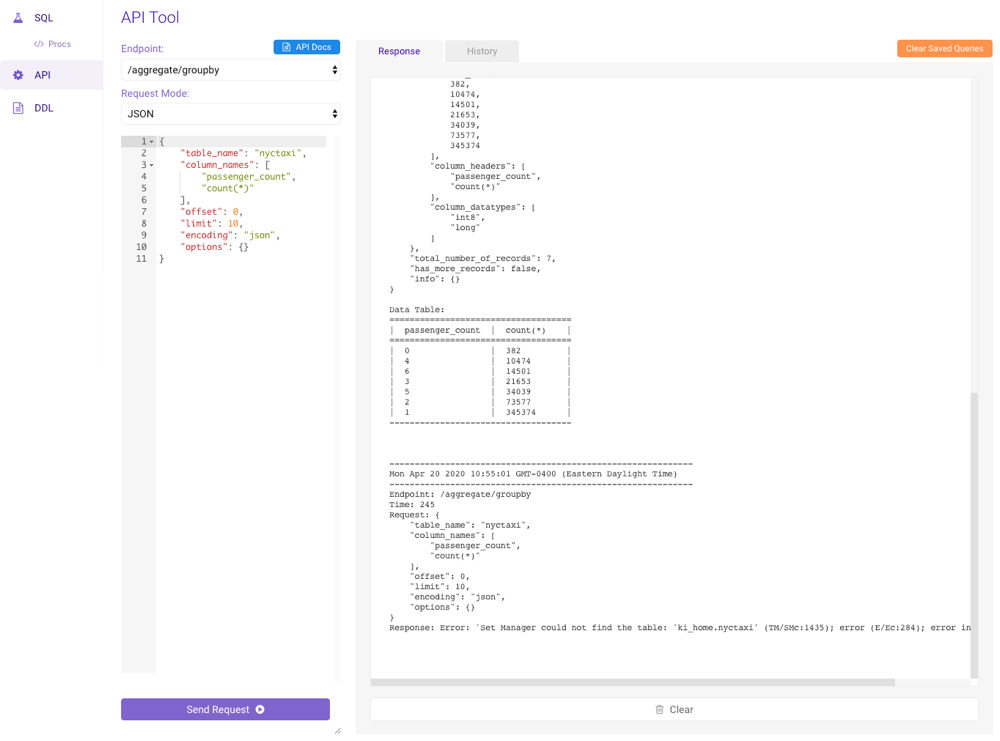
The **JSON** mode of the *API Tool* provides a user entry
control to enter the request parameters as a single block of JSON. The last
JSON request will be saved until the next time the endpoint is queried.
Here is an example of a request to the [/aggregate/groupby](/content/api/rest/aggregate_groupby_rest) endpoint
in **JSON** mode:
### JSON
The **JSON** mode of the *API Tool* provides a user entry
control to enter the request parameters as a single block of JSON. The last
JSON request will be saved until the next time the endpoint is queried.
Here is an example of a request to the [/aggregate/groupby](/content/api/rest/aggregate_groupby_rest) endpoint
in **JSON** mode:
 ## DDL Tool
The *DDL Tool* provides the ability to generate DDL for a given *table*,
*schema*, or all database entities at once.
## DDL Tool
The *DDL Tool* provides the ability to generate DDL for a given *table*,
*schema*, or all database entities at once.
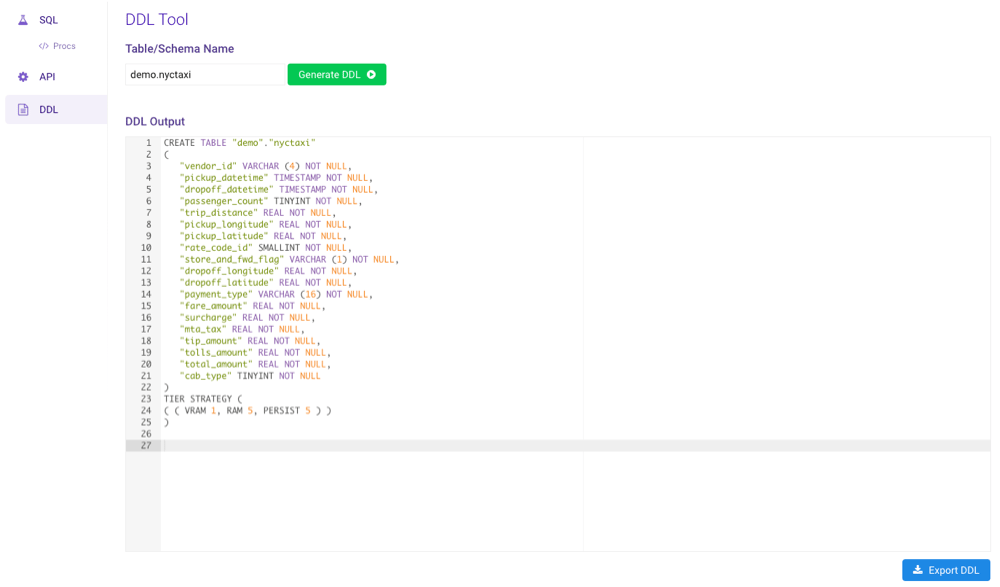 Enter a *table* name, *schema* name, or `*`, and click
**Generate DDL** to output the DDL to **DDL Output**. Click
**Export DDL** to save the generated DDL as a SQL script.
The output from this utility can be copied into the **SQL Statements**
area on the **SQL Tool** page and run in order to regenerate the
database entities whose DDL has been generated.
Enter a *table* name, *schema* name, or `*`, and click
**Generate DDL** to output the DDL to **DDL Output**. Click
**Export DDL** to save the generated DDL as a SQL script.
The output from this utility can be copied into the **SQL Statements**
area on the **SQL Tool** page and run in order to regenerate the
database entities whose DDL has been generated.