> ## Documentation Index
> Fetch the complete documentation index at: https://docs.kinetica.com/llms.txt
> Use this file to discover all available pages before exploring further.
# HDFS Import
Using the *HDFS Import* wizard, files located in *HDFS* can be imported into
*Kinetica*.
To import a file from *HDFS* into *Kinetica*, click on the
**HDFS** panel on the [Import](/content/admin/workbench/ui/import) landing page in
[Workbench](/content/admin/workbench).
The **HDFS Import** wizard appears in the right-hand pane.
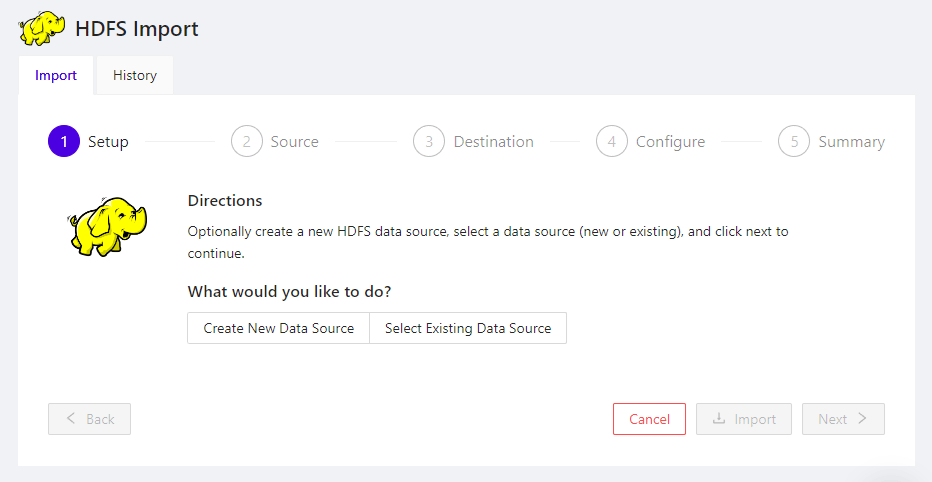 The wizard has two tabs:
* **Import** - contains the 5-step process for importing files
from *HDFS*
* **History** - lists all of your previous *HDFS* import attempts
## Import Overview
When importing, the following five steps will need to be completed:
* [Setup](#setup)
* [Source](#source)
* [Destination](#destination)
* [Configure](#configure)
* [Summary](#summary)
At any step, the following actions are available at the bottom of the screen:
* **Next** - proceed to the next step
* **Back** - return to the previous step
* **Cancel** - exit the import process
* **Import** - once enough information has been specified to
begin importing data, the **Import** button will become active
## Setup
In this step, the [data source](/content/sql/ddl#sql-create-data-source) used to
connect to *HDFS* is selected.
* **Create New Data Source** - click to create a new
*data source* that connects to *HDFS*, then enter its configuration and click
**Create** to create the *data source* and proceed to the
**Source** selection page:
* **Name** - enter a unique name for the *data source*
* **URL** - enter the host & port of the *HDFS* service
to use
* **Auth Type** - select an authorization scheme; this will
prompt with the appropriate fields for the scheme selected
* **Select Existing Data Source** - click to select an existing
*data source* that connects to *HDFS* and then click
**Next** to proceed to the **Source** selection
page:
* **Data Source** - click to open a drop-down of available
*data sources* that connect to *HDFS* and select one
## Source
In this step, the source file is selected and the parser configured for the
file, if necessary.
* **Source** - pre-selected as the name of the *data source*
chosen in the previous step
* **File Path** - enter the path to the file located within
*HDFS*
* **Format** - select the format of the file from the drop-down
If the source data is in a delimited text file, options for parsing the file can
be specified (see [Delimited Text Options](/content/sql/load#sql-load-file-server-delim-opt) for details):
* **Delimiter** - select the character that delimits field values
in the source file:
* `|` - default delimiter for .psv (pipe-separated value)
files
* `\t` - (tab) default delimiter for .tsv
(tab-separated value) files
* `,` - default delimiter for .csv (comma-separated value)
files and all other types of text files
* **Escape Character** - select the character used to escape
special characters (like the field delimiter) found within field values; e.g.,
a `\` might be used to escape commas within field values in a
.csv file
* **Comment Identifier** - select the character(s) with which
comment lines within the source file begin
* **Quote Character** - select the character used to quote field
values; e.g., a `"` might be used to quote field values containing commas in
a .csv file
* **Null Identifier** - select the character(s) used to identify
*null* field values
* **Has Header** - check the box if the source file contains a
header row at the top
Once the source file and parameters have been selected, click
**Next** to proceed to the **Destination**
selection page.
## Destination
In this step, the target table to import into is selected.
* **Schema** - name of the schema containing the target table;
if blank, the user's [default schema](/content/concepts/schemas#schema-default) will be
used
* **Table** - name of the target table, which must meet
[table naming criteria](/content/concepts/tables#table-naming-criteria); *Workbench* will
suggest a table name here, if possible
* **Batch Size** - number of records from the source to
insert into the database at a time; this can be used to tune the ingest speed
for source data with many records or wide columns
* **Abort on Error** - check, to have the import stop at the
first record import failure; any records imported by this point will remain in
the target table
* **Bad Records Table** - when **Abort on Error**
is unchecked, the errant records will be written to the specified table
* **Schema** - schema in which the bad records table should
reside
* **Table** - name for the bad records table
Once the destination has been specified, click **Next** to
proceed to the **Configure** page.
## Configure
In this step, the target table's structure can be specified, if the table does
not exist. Not specifying any structure will cause the import process to infer
the table's structure from the source data.
To specify a table structure, click **+ Add Column** once for
each field in the source data, then enter the specification for each column,
including:
* **Name** - name of the column, which must meet the standard
[naming criteria](/content/concepts/tables#table-naming-criteria)
* **Type** - type of the column, and sub-type, if applicable
* **Nullable** - check the box if the column should allow *null*
values
* **Properties** - check any properties that should apply to this
column:
* **Primary Key** - make this column the
[primary key](/content/concepts/tables#primary-key) or part of a
*composite primary key*
* **Shard Key** - make this column the
[shard key](/content/concepts/tables#shard-key) or part of a
*composite shard key*
* **Dict. Encoded** - apply
[dictionary encoding](/content/concepts/dictionary_encoding) to the
column's values, reducing storage used for columns with more often repeated
data
* **Init. with Now** - replace empty or invalid values inserted
into this column with the current date/time
* **Init. with UUID** - replace empty values inserted into this
column with a universally unique identifier (UUID)
* **Text Search** - make this column
[full-text searchable](/content/concepts/full_text_search), using
[FILTER\_BY\_STRING](/content/sql/query#sql-string-functions-fts) in *search* mode
To remove a column from the proposed target table, click the trash can icon at
the far right of the column's definition.
Once the table configuration has been established, click **Next**
to proceed to the **Summary** page.
## Summary
In this step, the import configuration will be displayed.
All **Source**, **Destination**, &
**Error Handling** configuration will be displayed in their
respective sections.
The **Generated SQL** section will contain the SQL
[LOAD INTO](/content/sql/load#sql-load-into) command corresponding to the import
operation that will take place. The copy-to-clipboard icon can be used to copy
the SQL statement for subsequent use, to re-import data from the same file into
the same table.
Once the import configuration has been confirmed, click
**Import** to import the file's data.
The wizard has two tabs:
* **Import** - contains the 5-step process for importing files
from *HDFS*
* **History** - lists all of your previous *HDFS* import attempts
## Import Overview
When importing, the following five steps will need to be completed:
* [Setup](#setup)
* [Source](#source)
* [Destination](#destination)
* [Configure](#configure)
* [Summary](#summary)
At any step, the following actions are available at the bottom of the screen:
* **Next** - proceed to the next step
* **Back** - return to the previous step
* **Cancel** - exit the import process
* **Import** - once enough information has been specified to
begin importing data, the **Import** button will become active
## Setup
In this step, the [data source](/content/sql/ddl#sql-create-data-source) used to
connect to *HDFS* is selected.
* **Create New Data Source** - click to create a new
*data source* that connects to *HDFS*, then enter its configuration and click
**Create** to create the *data source* and proceed to the
**Source** selection page:
* **Name** - enter a unique name for the *data source*
* **URL** - enter the host & port of the *HDFS* service
to use
* **Auth Type** - select an authorization scheme; this will
prompt with the appropriate fields for the scheme selected
* **Select Existing Data Source** - click to select an existing
*data source* that connects to *HDFS* and then click
**Next** to proceed to the **Source** selection
page:
* **Data Source** - click to open a drop-down of available
*data sources* that connect to *HDFS* and select one
## Source
In this step, the source file is selected and the parser configured for the
file, if necessary.
* **Source** - pre-selected as the name of the *data source*
chosen in the previous step
* **File Path** - enter the path to the file located within
*HDFS*
* **Format** - select the format of the file from the drop-down
If the source data is in a delimited text file, options for parsing the file can
be specified (see [Delimited Text Options](/content/sql/load#sql-load-file-server-delim-opt) for details):
* **Delimiter** - select the character that delimits field values
in the source file:
* `|` - default delimiter for .psv (pipe-separated value)
files
* `\t` - (tab) default delimiter for .tsv
(tab-separated value) files
* `,` - default delimiter for .csv (comma-separated value)
files and all other types of text files
* **Escape Character** - select the character used to escape
special characters (like the field delimiter) found within field values; e.g.,
a `\` might be used to escape commas within field values in a
.csv file
* **Comment Identifier** - select the character(s) with which
comment lines within the source file begin
* **Quote Character** - select the character used to quote field
values; e.g., a `"` might be used to quote field values containing commas in
a .csv file
* **Null Identifier** - select the character(s) used to identify
*null* field values
* **Has Header** - check the box if the source file contains a
header row at the top
Once the source file and parameters have been selected, click
**Next** to proceed to the **Destination**
selection page.
## Destination
In this step, the target table to import into is selected.
* **Schema** - name of the schema containing the target table;
if blank, the user's [default schema](/content/concepts/schemas#schema-default) will be
used
* **Table** - name of the target table, which must meet
[table naming criteria](/content/concepts/tables#table-naming-criteria); *Workbench* will
suggest a table name here, if possible
* **Batch Size** - number of records from the source to
insert into the database at a time; this can be used to tune the ingest speed
for source data with many records or wide columns
* **Abort on Error** - check, to have the import stop at the
first record import failure; any records imported by this point will remain in
the target table
* **Bad Records Table** - when **Abort on Error**
is unchecked, the errant records will be written to the specified table
* **Schema** - schema in which the bad records table should
reside
* **Table** - name for the bad records table
Once the destination has been specified, click **Next** to
proceed to the **Configure** page.
## Configure
In this step, the target table's structure can be specified, if the table does
not exist. Not specifying any structure will cause the import process to infer
the table's structure from the source data.
To specify a table structure, click **+ Add Column** once for
each field in the source data, then enter the specification for each column,
including:
* **Name** - name of the column, which must meet the standard
[naming criteria](/content/concepts/tables#table-naming-criteria)
* **Type** - type of the column, and sub-type, if applicable
* **Nullable** - check the box if the column should allow *null*
values
* **Properties** - check any properties that should apply to this
column:
* **Primary Key** - make this column the
[primary key](/content/concepts/tables#primary-key) or part of a
*composite primary key*
* **Shard Key** - make this column the
[shard key](/content/concepts/tables#shard-key) or part of a
*composite shard key*
* **Dict. Encoded** - apply
[dictionary encoding](/content/concepts/dictionary_encoding) to the
column's values, reducing storage used for columns with more often repeated
data
* **Init. with Now** - replace empty or invalid values inserted
into this column with the current date/time
* **Init. with UUID** - replace empty values inserted into this
column with a universally unique identifier (UUID)
* **Text Search** - make this column
[full-text searchable](/content/concepts/full_text_search), using
[FILTER\_BY\_STRING](/content/sql/query#sql-string-functions-fts) in *search* mode
To remove a column from the proposed target table, click the trash can icon at
the far right of the column's definition.
Once the table configuration has been established, click **Next**
to proceed to the **Summary** page.
## Summary
In this step, the import configuration will be displayed.
All **Source**, **Destination**, &
**Error Handling** configuration will be displayed in their
respective sections.
The **Generated SQL** section will contain the SQL
[LOAD INTO](/content/sql/load#sql-load-into) command corresponding to the import
operation that will take place. The copy-to-clipboard icon can be used to copy
the SQL statement for subsequent use, to re-import data from the same file into
the same table.
Once the import configuration has been confirmed, click
**Import** to import the file's data.