> ## Documentation Index
> Fetch the complete documentation index at: https://docs.kinetica.com/llms.txt
> Use this file to discover all available pages before exploring further.
# High Availability Architecture
The *Kinetica HA* eliminates the single point of failure in a standard
*Kinetica* cluster and provides recovery from failure. It is implemented
within the cluster to utilize multiple replicas of data and provides an
*eventually consistent* data store, by default. Through modification of the
configuration, *immediate consistency* can also be achieved, though at a
performance cost.
HA Architecture
The *Kinetica HA* solution consists of four components: an HA-aware client
process, high-availability processors within each head node and worker node
process in a cluster, two or more *Kinetica* clusters, and a
*Distributed Messaging Queue (DMQ)*. A high-level diagram of the *Kinetica HA*
solution is shown in the [High Availability Architecture](/content/ha/ha_architecture#figure-ha-arch) diagram.
The diagram depicts a three-cluster *Kinetica HA ring*. Each head node and
worker node process in the cluster contains one *HA* processor (the main HA
processing component), thus making *HA* processing internal to the core
database. This reduces the complexity of the HA solution and allows each head
node and/or worker node process in the cluster to communicate directly with the
*DMQ* as necessary. By doing this, if a head node or worker node process is
down, then the associated cluster can be assumed to be down. This assumption
simplifies the request processing and speeds up the HA solution. The diagram
also shows that the *DMQ* contains one *message queue* per cluster. While the
grouping of queues & clusters is a logical one, it can also be a physical one,
reusing each cluster's hardware. However, it is recommended that the queues
themselves exist on hardware separate from the cluster in order to optimize
performance, separating synchronization management from request processing.
There may also be more than one *message queue* per cluster as more instances
of *message queues* are used for redundancy.
## Failover Modes
A *Kinetica ring* itself operates in an *active/active* state, by default.
However, whether it effectively operates in *active/active* or *active/passive*
modes is governed by its clients:
* *Active/Active* - clients are configured to connect to any cluster in the
*HA ring* randomly
* *Active/Passive* - clients are configured to connect to a specific cluster in
the *HA ring* and maintain communications as long as that "active" cluster is
up; in the event that the cluster goes offline, clients will fail over to a
random "passive" cluster in the *HA ring*
## Failure and Recovery
Head node or worker node process (and by extension, *HA* processor) failure is
possible due to hardware or software failure or the associated cluster being
down (either planned or unplanned). Given that all access to the corresponding
cluster's services is through that process, all services will be unavailable.
During this time, any requests coming from clients will fail, and those clients
will redirect their requests to the remaining other clusters.
For non-query operations, the *HA* processor will also write the request to the
*DMQ*. When any crashed head node or worker node process comes back online and
before it starts servicing requests, it will fetch all the queued operations
from the *DMQ* which were stored during its downtime, and replay them in
sequence on its corresponding cluster. [Query operations](/content/ha/ha_architecture#ha-op-query)
are written to *DMQ*, by default, including those that create result set
views, though this behavior can be altered via configuration. For all kinds of
operations, once the client process is aware that its current targeted cluster
is down, it will fail over to a randomly chosen cluster in its list that is
still alive.
An *HA* processor does not store any data locally and always writes to and reads
from the highly-available *DMQ*. Therefore, there is no need to restore or
backup any files on behalf of an *HA* processor.
## High Availability Processing
*Kinetica* achieves [eventual consistency](/content/ha/ha_architecture#ha-event-cons) through
effective rule-based [operation handling](/content/ha/ha_architecture#ha-op).
### Operation Handling
A typical interaction with *Kinetica* begins with a client initiating a request
with its corresponding HA-aware client process. The client process sends the
request to the primary cluster in its internal list of clusters. The *HA*
processors will then process the request according to its internal request
categorization scheme, comprising three operation types:
* [Synchronous operations](/content/ha/ha_architecture#ha-op-sync)
* [Asynchronous operations](/content/ha/ha_architecture#ha-op-async)
* [Queries](/content/ha/ha_architecture#ha-op-query)
#### Synchronous Operations
Operations in this category are determined to be critical to the successful
execution of subsequent requests, and in a default installation, include DDL
and system/administrative endpoints. They will be relayed to all *Kinetica*
clusters and only succeed if the request is processed successfully by all
available clusters. Requests in this category should execute & return quickly,
as no further requests will be processed by the receiving cluster for the
requesting client until that client's *synchronous operation* is finished and
the necessary information is communicated to the *DMQ*. Also, requests can be
passed sequentially or in parallel to the other clusters, the former taking 3
times as long as the latter to perform the requested operation on a 3-cluster
*Kinetica* ring, for example.
An example *synchronous operation* request is one to create a table. The
table is created in all available clusters, or if an application-level error
occurs, the request is rejected back to the client. In this way, the client can
be assured that subsequent requests issued to *Kinetica*, which may be failed
over to other clusters, will have that table available. Note that this does not
guarantee the presence of the table for other clients issuing requests shortly
after the create table request; i.e. the system will not block further requests
across all clusters until a given *synchronous operation* is processed.
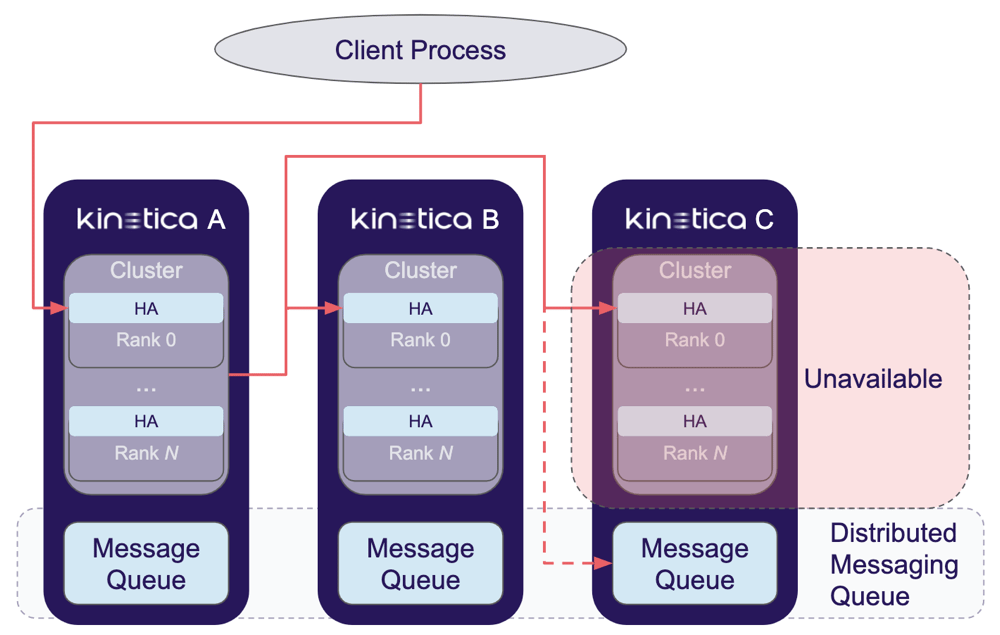 *Kinetica* will handle requests in this category as follows:
1. The request is issued to given cluster and a result is received. If an
application-level error occurs, the request will be rejected back to the
client. If an availability error occurs (connection times out,
connection refused, etc...), the request will be rejected back to the
client process, which will forward the same request to the next available
cluster and restart this service flow.
2. If the request is successful on the initial cluster, an *HA* processor
will then issue the same request directly to each of the other available
clusters, either one after the other or all at once, at the user's direction.
If any operation fails against a cluster, it will be stored in that cluster's
*message queue* for later replay during recovery
*(the case shown with the downed Kinetica C in the diagram)*.
3. Once the receiving *HA* processor has received responses from all other
clusters, it will return a success response to the client via the client
process.
#### Asynchronous Operations
Operations in this category are determined to be important for data consistency
across the *Kinetica* clusters, but not to the successful execution of
subsequent requests. In a default installation, these include DML endpoints.
They will be serviced immediately by the receiving cluster and added to the
*message queues* of the remaining clusters and serviced in a timely fashion.
Success is determined by the result of the operation on the original cluster
only. Because of this asynchronicity, requests in this category can be
long-running and will only take as much time as the request takes on a single
cluster with some marginal HA-related overhead. Also, requests can be passed
sequentially or in parallel to the other clusters, the former taking 3 times as
long as the latter to queue the requested operations on a 3-cluster *Kinetica*
ring, for example.
An example *asynchronous operation* request is one to insert records into a
table. The requested records are inserted immediately into the receiving
cluster and queued for insert into the remaining clusters, where they will be
available shortly afterwards.
*Kinetica* will handle requests in this category as follows:
1. The request is issued to given cluster and a result is received. If an
application-level error occurs, the request will be rejected back to the
client. If an availability error occurs (connection times out,
connection refused, etc...), the request will be rejected back to the
client process, which will forward the same request to the next available
cluster and restart this service flow.
2. If the request is successful on the initial cluster, an *HA* processor
will then issue the same request directly to each of the other available
clusters, either one after the other or all at once, at the user's direction.
If any operation fails against a cluster, it will be stored in that cluster's
*message queue* for later replay during recovery
*(the case shown with the downed Kinetica C in the diagram)*.
3. Once the receiving *HA* processor has received responses from all other
clusters, it will return a success response to the client via the client
process.
#### Asynchronous Operations
Operations in this category are determined to be important for data consistency
across the *Kinetica* clusters, but not to the successful execution of
subsequent requests. In a default installation, these include DML endpoints.
They will be serviced immediately by the receiving cluster and added to the
*message queues* of the remaining clusters and serviced in a timely fashion.
Success is determined by the result of the operation on the original cluster
only. Because of this asynchronicity, requests in this category can be
long-running and will only take as much time as the request takes on a single
cluster with some marginal HA-related overhead. Also, requests can be passed
sequentially or in parallel to the other clusters, the former taking 3 times as
long as the latter to queue the requested operations on a 3-cluster *Kinetica*
ring, for example.
An example *asynchronous operation* request is one to insert records into a
table. The requested records are inserted immediately into the receiving
cluster and queued for insert into the remaining clusters, where they will be
available shortly afterwards.
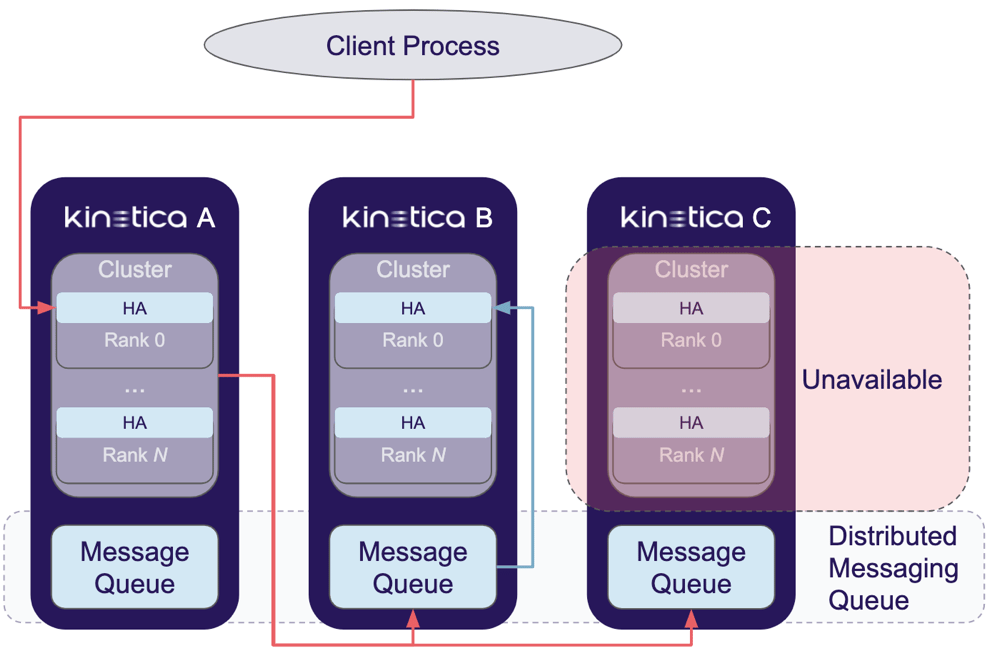 *Kinetica* will handle requests in this category as follows:
1. The request is issued to a given cluster and a result is received. If an
application-level error occurs, the request will be rejected back to the
client. If an availability error occurs (connection times out,
connection refused, etc...), the request will be rejected back to the
client process, which will forward the same request to the next
available cluster and restart this service flow.
2. If the request is successful on the initial cluster, an *HA* processor on
the receiving cluster will then publish the request to the *message queue*
associated with each of the other clusters for later processing, either one
after the other or all at once, at the user's direction. Note that requests
are published to the *message queues* regardless of the up or down state of
the corresponding clusters, though only alive clusters will pull operations
off of the queue *(the case shown with the up Kinetica B &*
*downed Kinetica C in the diagram)*.
3. Once the receiving cluster has finished publishing the request, it
will return a success response to the client via the client process.
#### Queries
Operations in this category are determined to be able to run on any single
available cluster and not require any synchronization across clusters. In a
default installation, these include data retrieval endpoints. They will be
serviced immediately by the receiving cluster and return immediately. As they
only run on the receiving cluster, success is only determined by the result of
the operation on that cluster.
An example *query* request is one to aggregate records by groups and return the
resulting data set. Since all available clusters should be consistent, aside
from any pending [asynchronous operations](/content/ha/ha_architecture#ha-op-async), any single
cluster should be able to service the request.
*Kinetica* will handle requests in this category as follows:
1. The request is issued to a given cluster and a result is received. If an
application-level error occurs, the request will be rejected back to the
client. If an availability error occurs (connection times out,
connection refused, etc...), the request will be rejected back to the
client process, which will forward the same request to the next
available cluster and restart this service flow.
2. If the request is successful on the initial cluster, an *HA* processor on
the receiving cluster will then publish the request to the *message queue*
associated with each of the other clusters for later processing, either one
after the other or all at once, at the user's direction. Note that requests
are published to the *message queues* regardless of the up or down state of
the corresponding clusters, though only alive clusters will pull operations
off of the queue *(the case shown with the up Kinetica B &*
*downed Kinetica C in the diagram)*.
3. Once the receiving cluster has finished publishing the request, it
will return a success response to the client via the client process.
#### Queries
Operations in this category are determined to be able to run on any single
available cluster and not require any synchronization across clusters. In a
default installation, these include data retrieval endpoints. They will be
serviced immediately by the receiving cluster and return immediately. As they
only run on the receiving cluster, success is only determined by the result of
the operation on that cluster.
An example *query* request is one to aggregate records by groups and return the
resulting data set. Since all available clusters should be consistent, aside
from any pending [asynchronous operations](/content/ha/ha_architecture#ha-op-async), any single
cluster should be able to service the request.
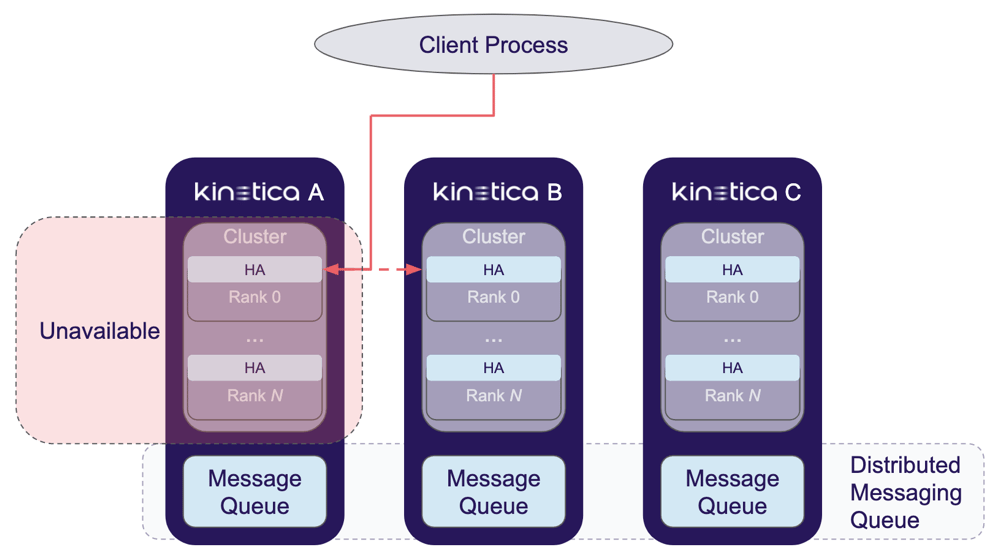 *Kinetica* will handle requests in this category as follows:
1. The request is issued to a given cluster and a result is received.
If an application-level error occurs, the request will be rejected back
to the client. If an availability error occurs (connection times out,
connection refused, etc...), the request will be rejected back to the
client process, which will forward the same request to the next
available cluster and restart this service flow
*(the case shown with the downed Kinetica A & up Kinetica B in the*
*diagram)*.
2. If the request is successful on the initial cluster, a success response
is returned to the client via the client process.
### Eventual Consistency
The *Kinetica* clusters within a given installation will reach
*eventual consistency* through the combined synchronous & asynchronous
processing of operations from other clusters during normal conditions and
through in-sequence processing of queued operations during recovery.
#### Data Synchronization
During normal operation, [asynchronous operations](/content/ha/ha_architecture#ha-op-async)
received & processed by one cluster will be published to the
*message queue* of each of the other clusters. In addition to receiving client
requests, the *HA* processors on the head node and worker node processes also
poll the respective cluster's *message queue* for newly queued asynchronous
operations and processes them. In the default configuration, insert requests
are pulled off of the queue and executed in multi-threaded fashion. Updates &
deletes, on the other hand, will block until all in-flight insert requests have
finished and then be processed afterwards. This ordering mechanism only applies
to requests pulled off the *message queue*, and has no bearing on the handling
of external client requests.
This leads to *eventual consistency*, as each cluster, either via handling
*asynchronous operations* directly from clients, or indirectly via the
*message queue*, will end up processing all client requests.
#### Recovery
*Kinetica* will handle requests in this category as follows:
1. The request is issued to a given cluster and a result is received.
If an application-level error occurs, the request will be rejected back
to the client. If an availability error occurs (connection times out,
connection refused, etc...), the request will be rejected back to the
client process, which will forward the same request to the next
available cluster and restart this service flow
*(the case shown with the downed Kinetica A & up Kinetica B in the*
*diagram)*.
2. If the request is successful on the initial cluster, a success response
is returned to the client via the client process.
### Eventual Consistency
The *Kinetica* clusters within a given installation will reach
*eventual consistency* through the combined synchronous & asynchronous
processing of operations from other clusters during normal conditions and
through in-sequence processing of queued operations during recovery.
#### Data Synchronization
During normal operation, [asynchronous operations](/content/ha/ha_architecture#ha-op-async)
received & processed by one cluster will be published to the
*message queue* of each of the other clusters. In addition to receiving client
requests, the *HA* processors on the head node and worker node processes also
poll the respective cluster's *message queue* for newly queued asynchronous
operations and processes them. In the default configuration, insert requests
are pulled off of the queue and executed in multi-threaded fashion. Updates &
deletes, on the other hand, will block until all in-flight insert requests have
finished and then be processed afterwards. This ordering mechanism only applies
to requests pulled off the *message queue*, and has no bearing on the handling
of external client requests.
This leads to *eventual consistency*, as each cluster, either via handling
*asynchronous operations* directly from clients, or indirectly via the
*message queue*, will end up processing all client requests.
#### Recovery
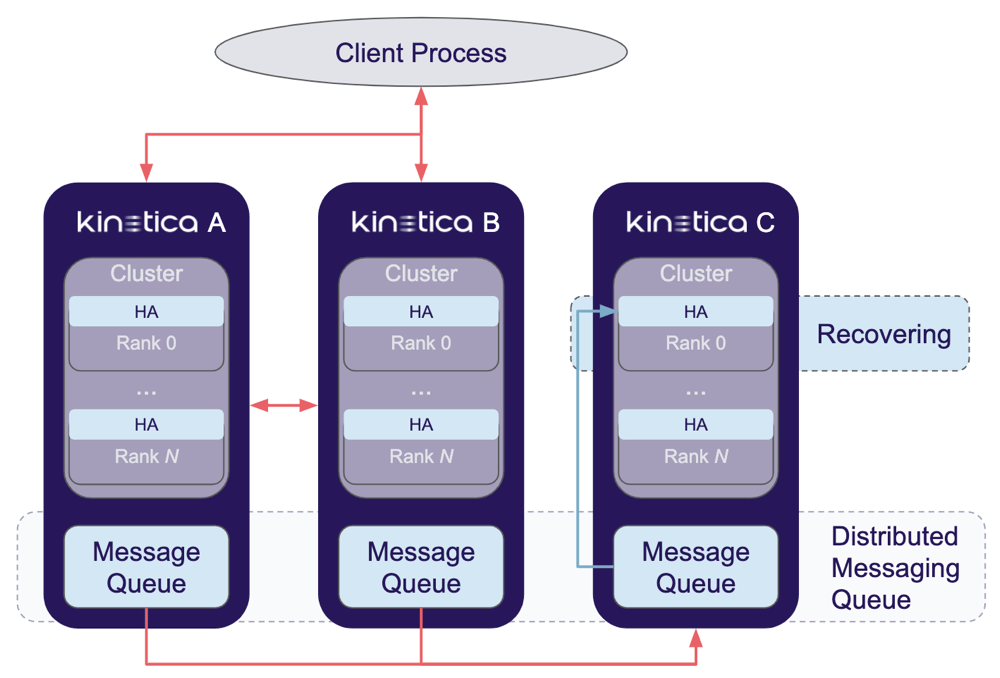 When a cluster enters into a failed state, inbound client requests will begin to
accumulate on its corresponding *message queue*. When the failure has
been corrected and the cluster restarted, the *HA* processors will begin the
recovery synchronization process as follows:
1. As the cluster comes up and starts its recovery process, all operations
being executed against it by other live clusters will continue to be
queued. At this point, the associated cluster is still marked as
unavailable and will not yet handle new inbound requests.
2. The recovering cluster's *HA* processors will check its *message queue*
for requests and service those in queued order.
3. Once the queue has been drained, the *HA* processors will be ready for new
requests.
In the diagram, *Kinetica C* is in recovery mode and will be marked as
unavailable until it has finished with its queued operations. While it
recovers, *Kinetica A* & *Kinetica B* will continue to serve requests, adding
all operations to its *message queue*.
When a cluster enters into a failed state, inbound client requests will begin to
accumulate on its corresponding *message queue*. When the failure has
been corrected and the cluster restarted, the *HA* processors will begin the
recovery synchronization process as follows:
1. As the cluster comes up and starts its recovery process, all operations
being executed against it by other live clusters will continue to be
queued. At this point, the associated cluster is still marked as
unavailable and will not yet handle new inbound requests.
2. The recovering cluster's *HA* processors will check its *message queue*
for requests and service those in queued order.
3. Once the queue has been drained, the *HA* processors will be ready for new
requests.
In the diagram, *Kinetica C* is in recovery mode and will be marked as
unavailable until it has finished with its queued operations. While it
recovers, *Kinetica A* & *Kinetica B* will continue to serve requests, adding
all operations to its *message queue*.
