A set of results returned by Kinetica.getGraphEntities. More...
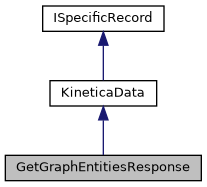
 Inheritance diagram for GetGraphEntitiesResponse:
 Collaboration diagram for GetGraphEntitiesResponse: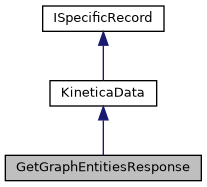
Properties | |
| bool | result [get, set] |
| Indicates a successful retrieval. More... | |
| IList< long > | entities_int = new List<long>() [get, set] |
| Flat array of entity data for integer-identifier graphs with a repeating stride. More... | |
| IList< string > | entities_string = new List<string>() [get, set] |
| Flat array of entity data for name-identifier (string) graphs only. More... | |
| IList< double > | entities_double = new List<double>() [get, set] |
| Compact double-packed payload for WKT (geo/XY) graphs. More... | |
| IList< float > | entities_weight = new List<float>() [get, set] |
Per-edge weight values, populated only when the request option 'include_weights' is 'true' and options entity_type is 'edge'. More... | |
| IList< string > | labels = new List<string>() [get, set] |
| Array of distinct label strings. More... | |
| IDictionary< string, string > | info = new Dictionary<string, string>() [get, set] |
| Additional information map. More... | |
| Properties inherited from KineticaData | |
| Schema | Schema [get] |
| Avro Schema for this class More... | |
| Properties inherited from Avro.Specific.ISpecificRecord | |
| Schema | Schema [get] |
Additional Inherited Members | |
| Public Member Functions inherited from KineticaData | |
| KineticaData (KineticaType type) | |
| Constructor from Kinetica Type More... | |
| KineticaData (System.Type type=null) | |
| Default constructor, with optional System.Type More... | |
| object | Get (int fieldPos) |
| Retrieve a specific property from this object More... | |
| void | Put (int fieldPos, object fieldValue) |
| Write a specific property to this object More... | |
| Static Public Member Functions inherited from KineticaData | |
| static ? RecordSchema | SchemaFromType (System.Type t, KineticaType? ktype=null) |
| Create an Avro Schema from a System.Type and a KineticaType. More... | |
Detailed Description
A set of results returned by Kinetica.getGraphEntities.
Definition at line 363 of file GetGraphEntities.cs.
Property Documentation
◆ entities_double
|
getset |
Compact double-packed payload for WKT (geo/XY) graphs.
WKT graphs ALWAYS use this array — 'POINT(x y)' strings are never emitted anywhere. Stride 3 for nodes: [x, y, label_index, ...]. Stride 6 for edges (non-concise): [edge_id, x0, y0, x1, y1, label_index, ...]. Empty for non-WKT graphs and when concise mode emits edges into entities_int instead. label_index/edge_id occupy double slots (representable exactly up to 2^53). When 'concise_edge_connectivity' is 'true' and entity_type is 'node', tombstoned (deleted) WKT slots emit [0.0, 0.0, 0.0] to keep position indices stable. Roughly 4x smaller on the wire than 'POINT(x y)' strings and avoids any client-side regex parse.
Definition at line 407 of file GetGraphEntities.cs.
◆ entities_int
|
getset |
Flat array of entity data for integer-identifier graphs with a repeating stride.
For node entities (stride 2): [node_id, label_index, ...]. For edge entities (stride 4): [edge_id, node1_id, node2_id, label_index, ...]. Populated when the graph uses integer identifiers; empty otherwise. The label_index is a 1-based index into the labels array; 0 indicates no label. When the request option 'concise_edge_connectivity' is 'true', this array is also used (regardless of graph identifier type) for edge entities and carries [edge_id, node1_index, node2_index, edge_label_index] where node1_index/node2_index are 0-based positions into the node array returned from a paired node call on the same graph.
Definition at line 380 of file GetGraphEntities.cs.
◆ entities_string
|
getset |
Flat array of entity data for name-identifier (string) graphs only.
For node entities (stride 2): [node_name, label_index, ...]. For edge entities (stride 4): [edge_id, node1_name, node2_name, label_index, ...]. Populated only when the graph uses string identifiers. Empty for integer-identifier graphs (data goes to entities_int) and for WKT/geo-XY graphs (data always goes to entities_double — 'POINT(x y)' strings are never emitted). The label_index is a string representation of a 1-based index into the labels array; '0' indicates no label.
Definition at line 393 of file GetGraphEntities.cs.
◆ entities_weight
|
getset |
Per-edge weight values, populated only when the request option 'include_weights' is 'true' and options entity_type is 'edge'.
Stride 1, aligned 1:1 with the edge records emitted in entities_int or entities_string (i.e. the i-th weight corresponds to the i-th edge record). Empty when the graph has no weights component, when requesting nodes, or when the option is not set. Single-precision float matches the graph server's native weight storage.
Definition at line 418 of file GetGraphEntities.cs.
◆ info
|
getset |
Additional information map.
Contains the following keys: 'identifier_type' — describes the graph's native node identifier type: 'int', 'string', or 'wkt' (geo/XY graph). 'payload_type' — describes which array actually holds this response payload: 'int' (entities_int), 'string' (entities_string), or 'double' (entities_double). WKT graphs ALWAYS use 'double' for both nodes and edges — 'POINT(x y)' strings are never emitted. In concise edge mode payload_type is 'int' regardless of graph type. Clients should dispatch on 'payload_type', not 'identifier_type', to parse the response. 'total_count' — total number of entities available in the graph for the requested entity_type, used for pagination; this is the live (non-deleted) count by default, or the raw count (including deleted slots) when 'concise_edge_connectivity' is true for a node request. 'status_message' — set to 'Cancelled' if the request was cancelled mid-iteration (with result set to false). 'concise_edge_connectivity' — set to 'true' when the response was produced with the concise option (edges emitted as [edge_id, v0_index, v1_index, label_idx] in entities_int; WKT-graph nodes emitted as [x, y, label_idx] in entities_double; non-WKT nodes still in their native array; node output includes deleted slots to keep indices stable). 'include_weights' — set to 'true' when entities_weight is populated.
Definition at line 450 of file GetGraphEntities.cs.
◆ labels
|
getset |
Array of distinct label strings.
The label_index values in entities_int, entities_string, or entities_double are 1-based indexes into this array; index 0 means no label.
Definition at line 425 of file GetGraphEntities.cs.
◆ result
|
getset |
Indicates a successful retrieval.
Definition at line 366 of file GetGraphEntities.cs.
The documentation for this class was generated from the following file:
- Kinetica/Protocol/GetGraphEntities.cs